

In my early years in Madrid, some 25 years ago, I loved walking the streets and ducking down into the metro to whizz around the city. I devoured the entire Lord of the Rings series and countless issues of the International Herald Tribune while riding on the metro. Back then, you could see everyone there: students, women and men in suits heading to their offices, workers in uniforms, older women decked out in furs. Madrid Metro was for everyone.
In 2010, I started teaching at Universidad Europea, just a short hop to Principe Pío, then the 518 bus to Villaviciosa de Odón. So, for about a decade, I didn’t spend a lot of time riding the metro. It was IE University’s move to the Four Towers in 2021 put me back on a regular metro commute.
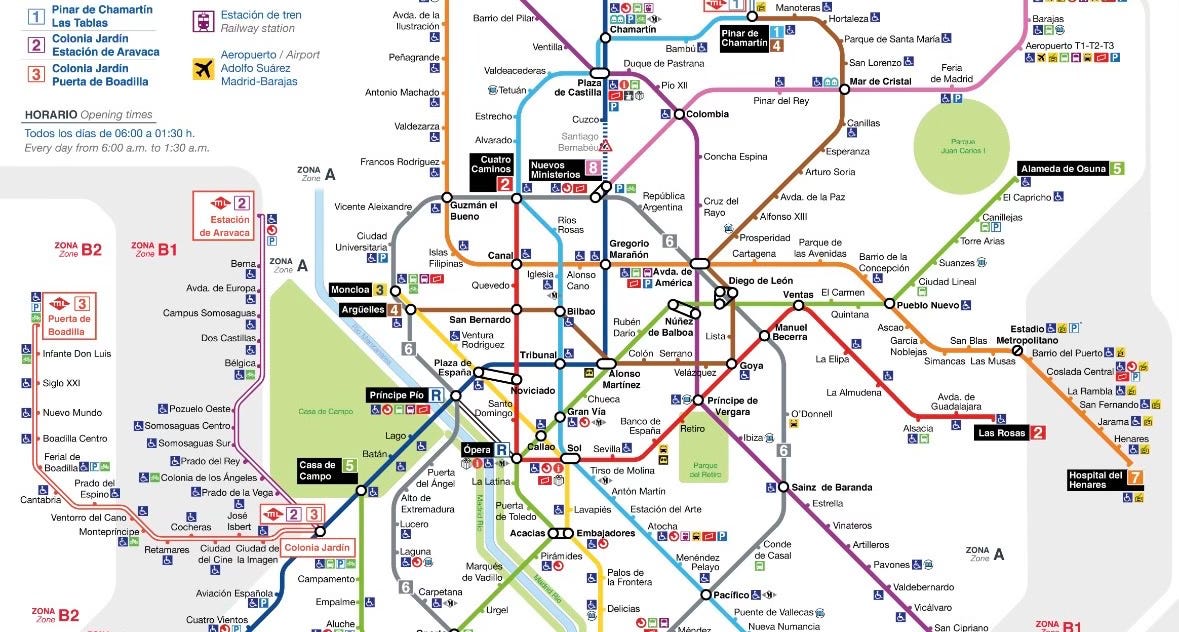
I was looking forward to settling in with a book as I rode up to Plaza Castilla on Line 1. Instead, I stepped into a sweltering car of people packed like sardines. I thought, oh, this must be a bad day. But no, it turned out to be what Line 1 had become during my hiatus.
As the year wore on, I found the fresh hell that awaited those of us who travel on Line 1 in the winter. As we all crammed into the car in our heavy coats, already emitting enough body heat to make us all sweat, someone somewhere pulled the lever to pump even more heat into the car. This offers us a terrible choice: struggle to pull off your coat and sweater or stand there stewing in your own sweat. Then there’s the shock of surfacing to the freezing cold street.
Termo de Madrid is a citizen-reporting project that tracks the temperature on the metro to raise the visibility of this issue. Click through to see the misery that too many Madrileños experience on the metro. 79% of passengers who submitted reports complained of no air conditioning on Line 1 and 28% on Line 5 at the end of August. This has been further exacerbated by the continuing closure of Line 10 between Nuevos Ministerios and Cuzco.
Riding the Madrid’s Metro these days feels like punishment. And what’s the crime? Not owning a car in the city center? Or not being able to afford a taxi ride? Wanting to contribute to cleaner air by taking public transport that was once the pride of Madrid?
To be fair, the Community of Madrid announced a €3.5 million project in May to better maintain the air-conditioning systems on 93 trains serving Lines 1 and 5. Yet, as we’ve seen, passengers on Lines 1 and 5 have continued reporting unbearably hot carriages throughout the summer. They also announced the purchase of 40 new trains for Line 1 back in 2024. The trains are supposed to enter service during the first half of 2027.
In the meantime, with the start of the academic year approaching, I began to search for a more sustainable and enjoyable way to travel to the Four Towers. Perhaps BiciMAD was the answer.
I started by purchasing a helmet and downloading the app with the idea of getting some practice on the quiet streets in August. Once set up, which wasn’t as easy as I expected, I went to the nearest bike station and got a bike out, only to quickly discover a broken front wheel. I managed to lock it back into the station, took out another and rode around the neighborhood.
I went for a second spin on a Sunday evening, thinking I’d at least try some of the route to the Four Towers. Again, the first bike was broken. The second was wobbly, but I nonetheless pedaled up the dedicated bike lane on Calle de Santa Engracia. Then, I almost got hit by a taxi driver turning left as I was trying to go straight through an intersection. With that I lost my nerve and just before I got to Cuatro Caminos, I turned back towards home.
Just a few blocks away from the bike station, I had another hair-raising near miss with a car that blasted through a stop sign.
Shaking as I heaved the bike back into its parking spot, I decided that this would not be my new commute. To make matters worse, I’ve now been charged for the few minutes it took me to realize that two different bikes I took out were broken. My conclusion is that I might use BiciMAD for short trips but riding all the way up to the Four Towers without dedicated bike lanes is just not for me.
And I’m not alone. According to a report that Ecologistas en Acción released in August, just 8% of Madrileños say they feel safe or comfortable cycling among cars. This translates into low ridership: only 1.3% of journeys inside the M-30 in 2024 were by bicycle. This is up from 0.6% in 2018 but remains dismal. Madrid lags far behind cities like Paris (11.1%), Berlin (18.2%) and Amsterdam (39%) and even Spanish cities like Sevilla (7%), Barcelona (4%) and Vitoria (8%).
What’s more dismaying is the map inside the report that shows a city full of bike routes that were planned back in 2008. These were supposed to be in place by 2025, but the map of the current situation is just a bunch of disconnected lines. No wonder so few people want to cycle around our fair city. There are too few routes that don’t involve sharing the road with the aggressive drivers while riding rickety bikes. It’s terrifying.
This matters well beyond the comfort of Madrileños trying to get to work each day. The City and Community of Madrid urge us to leave our cars at home while making the alternatives unreliable, unbearable or frightening. Yet whether we travel by metro, bus, bicycle or taxi, we all breathe the environmental consequences of policies that continue to privilege private cars.
A world-class transport system is one that people can use safely and comfortably every day. Madrid once offered public transport that few cities could match. Its leaders should be embarrassed by how far they have allowed it to fall.
This is the English version of my column, La Globalista, in El Español.
The cycling situation is no joke either. I'm fortunate to live in a city where cyclists are the norm and drivers know how to share the road, but back when I lived in the States, I can remember having cars clip my handlebars. Ended up giving up and taking the Metro (as bad as it is).
I hear you.